
Clothing (also known as clothes, garments, dress, apparel, or attire) is any item worn on a human body. Today, clothing is typically made of fabrics or textiles. Historically, it has included garments made from animal skin and other thin sheets of materials and natural products found in the environment.
Clothing is worn primarily by humans and is a feature of all human societies. The amount and type of clothing worn depend on gender, body type, social factors, and geographic considerations. Garments cover the body, footwear covers the feet, gloves cover the hands, hats and headgear cover the head, and underwear covers the intimate parts.
Beyond mere function, clothing manifests significant social factors, reflecting broader societal structures and values. It also serves to express human creativity as the wearer reveals their aesthetic preferences and observers can enjoy the varied appearances of others.
History


Clothing presents many challenges to historians. Clothing made of textiles or skins is subject to decay. Costume collections often focus on important pieces of clothing considered unique or otherwise significant, limiting the opportunities scholars have to study everyday clothing. Nevertheless, clothing reveals much about human history. The textile curator Linda Baumgarten writes that "clothing provides a remarkable picture of the daily lives, beliefs, expectations, and hopes of those who lived in the past.[1]
The development of clothing is deeply connected to human evolution, with early garments likely consisting of animal skins adapted for protection. The biblical account in Genesis accords with this assessment, recounting that when the first human beings were evicted from the Garden of Eden, "The Lord God made garments of skin for Adam and his wife and clothed them" (Genesis 3:21).
Estimates of when humans began wearing clothes range from 40,000 to as many as 3 million years ago. According to anthropologists and archaeologists, the earliest clothing likely consisted of fur, leather, leaves, or grass that was draped, wrapped, or tied around the body. Knowledge of such clothing remains inferential, as clothing materials deteriorate quickly compared with stone, bone, shell, and metal artifacts. Archeologists have identified a very early sewing needle made of bone among Denisovan remains at least 50,000 years old found in a Denisova Cave in Siberia.[2] Dyed flax fibers that date back to 34,000 B.C.E. and could have been used in clothing have been found in a prehistoric cave in Georgia.[3] Archeological evidence revealed clothes being made 120,000 years ago based on findings in deposits in Morocco.[4]
The oldest known piece of woven clothing is the Tarkhan dress, an over 5000-year-old linen garment.[5][6]
Over thousands of years of making clothing, humans have created an astonishing array of styles, many of which have been reconstructed from surviving garments, photographs, paintings, mosaics, and written descriptions. Costume history can inspire current fashion designers, as well as costumiers for plays, films, television, and historical reenactment.
Making clothing
Several distinct human Cultures, including those residing in the Arctic Circle, have historically crafted their garments exclusively from treated and adorned animal furs and skins. In contrast, numerous other societies have complemented or substituted leather and skins with textiles woven, knitted, or twined from a diverse array of animal and plant fibers, such as wool, linen, cotton, silk, hemp, and ramie.

Although modern consumers may take clothing production for granted, making fabric by hand is a tedious, labor-intensive process involving fiber preparation, spinning, and weaving. The textile industry was the first to be mechanized – with the powered loom – during the Industrial Revolution.
Different cultures have developed various ways of making clothes from cloth. One approach involves draping the cloth. Many people wore, and still wear, garments consisting of rectangles of cloth wrapped to fit – for example, the dhoti for men and the sari for women in the Indian subcontinent, the Scottish kilt, and the Javanese sarong. The clothes may be tied up (dhoti and sari) or held in place with pins or belts (kilt and sarong). The cloth remains uncut, and people of various sizes can wear the garment.
Another approach involves measuring, cutting, and sewing the cloth by hand or with a sewing machine. Clothing can be cut from a sewing pattern and adjusted by a tailor to the wearer's measurements. An adjustable sewing mannequin or dress form is used to create form-fitting clothing. If the fabric is expensive, the tailor tries to use every bit of the rectangular cloth when constructing the garment; perhaps cutting triangular pieces from one corner of the cloth and adding them elsewhere as gussets. Traditional European patterns for shirts and chemises take this approach. These remnants can also be reused to make patchwork pockets, hats, vests, and skirts.
Modern European fashion treats cloth much less conservatively, typically cutting in ways that leave various odd-shaped cloth remnants. Industrial sewing operations sell these as waste; domestic sewers may turn them into quilts.
Functions
Clothing serves many purposes: it can protect against the elements and other threats by providing a barrier between the skin and the environment. Fashioned with pockets, belts, or loops, clothing may provide a means to carry things while freeing the hands.
The choice of clothes also has social implications. Clothing performs a range of social and cultural functions, such as individual, occupational, gender differentiation, and social status.[7] In many societies, norms about clothing reflect standards of modesty, religion, gender, and social status. Clothing may also function as an adornment and an expression of personal taste or style. Someone who lacks the means to procure appropriate clothing due to poverty or affordability, or lack of inclination, may be viewed as ragged, or shabby.

Clothing has been made from a wide variety of materials, ranging from leather and furs to woven fabrics and elaborate, exotic natural and synthetic fabrics. Not all body coverings are regarded as clothing. Articles carried rather than worn normally are considered accessories rather than clothing (such as Handbags), items worn on a single part of the body and easily removed (scarves), worn purely for adornment (jewelry), or items that do not serve a protective function. For instance, corrective eyeglasses, Arctic goggles, and sunglasses would not be considered an accessory because of their protective functions.
Protection
The most obvious function of clothing is to protect the wearer from the elements. Clothes help to prevent wind damage and protect against sunburn. In the cold, they offers thermal insulation. They can provide protection against the elements, rough surfaces, sharp stones, rash-causing plants, and insect bites by providing a barrier between the skin and the environment. Clothing can insulate against cold or heat and provide a hygienic barrier, keeping infectious and toxic materials away from the body. It can protect feet from injury and discomfort or facilitate navigation in varied environments. Clothing also protects from ultraviolet radiation. Wearers may use it to reduce glare or improve visual acuity in harsh environments, such as when wearing brimmed hats.
Shelter can reduce the functional need for clothing. For example, coats, hats, gloves, and other outer layers are normally removed when entering a warm place. Similarly, clothing has seasonal and regional aspects, so thinner materials and fewer layers are generally worn in warmer regions and seasons than in colder ones. Boots, hats, jackets, ponchos, and coats designed to protect from rain and snow are specialized clothing items.
Appropriate clothes can also reduce risk during particular activities. Some clothing protects against specific hazards, such as insects, toxic chemicals, weather, and abrasive substances. Wearers may also use clothing for protection against injury in specific tasks and occupations, sports, and warfare.
Humans have devised clothing solutions to environmental or other hazards: such as space suits, armor, diving suits, swimsuits, bee-keeper gear, motorcycle leathers, high-visibility clothing, and other pieces of protective clothing. The distinction between clothing and protective equipment is not always clear-cut, since clothes designed to be fashionable often have protective value, and clothes designed for function often incorporate corporate fashion elements.
Comfort

Comfort is related to various perceptions and to physiological, social, and psychological needs. After food, clothing satisfies these comfort needs, providing aesthetic, tactile, thermal, moisture, and pressure comfort.[8]
- Aesthetic comfort
- Visual perception is influenced by color, fabric construction, style, garment fit, fashion compatibility, and finish of clothing material. Aesthetic comfort is necessary for psychological and social comfort.[8][9]
- Thermoregulation
- Thermophysiological comfort is provided by clothing material that maintains the balance of moisture and heat between the body and the environment. Particular textile materials create ease by maintaining moisture and thermal levels in a human's resting and active states. The selection of textile material significantly affects the wearer's comfort. Different textile fibers have unique properties that make them suitable for use in various environments. For example, natural fibers are breathable and absorb moisture, while synthetic fibers are hydrophobic, repel moisture, and do not allow air to pass. Different environments demand a diverse selection of clothing materials.[8][10] The major determinants that influence thermophysiological comfort are permeable construction, heat, and moisture transfer rate.[11]
- Thermal comfort
- One of the primary criteria for our physiological needs is thermal comfort. The heat-dissipation effectiveness of clothing gives the wearer a feeling that is neither very hot nor very cold. The optimum temperature for thermal comfort of the skin surface is between 28 and 30°C (82 and 86°F). Discomfort is experienced when the temperature falls below or exceeds the neutral point on either side. Clothing maintains a thermal balance; it keeps the skin dry and cool. It helps to keep the body from overheating while avoiding heat from the environment.[8]
- Moisture comfort
- Moisture comfort is the prevention of a damp sensation. The body generally feels uncomfortable when more than half of it is wet.
- Tactile comfort
- Tactile comfort prevents discomfort related to the friction created by clothing against the body. It is related to the smoothness, roughness, softness, and stiffness of the fabric used in clothing. The degree of tactile discomfort may vary among individuals due to factors such as allergies, tickling, prickling, skin abrasion, coolness, and the fabric's weight, structure, and thickness. Soft, clingy, stiff, heavy, light, hard, sticky, scratchy, and prickly are all terms used to describe tactile sensations.[8] There are specific surface finishes (mechanical and chemical) that can enhance tactile comfort. Fleece sweatshirts and velvet clothing, for example.
- Pressure comfort
- The comfort of the human body's pressure receptors' (present in the skin) sensory response towards clothing. Fabric with Lycra feels more comfortable because of this response and superior pressure comfort. The sensation response is influenced by the material's structure: snugging, looseness, heaviness, lightness, softness, or stiffness.[8][12]
Cultural aspects
Clothing has long served as a marker of social status, gender, and cultural identity, reflecting broader societal structures and values.[13] Wearing clothes is a variable social norm. It may connote modesty; being deprived of clothing in front of others may be embarrassing. Pubic area or genital coverage is the most frequently encountered minimum across cultures and climates, implying social convention as the basis of customs. Wearers may also use clothing to communicate social status, wealth, group identity, and individualism.
Gender differentiation

In most cultures, gender differentiation of clothing is considered appropriate. The differences are in styles, colors, fabrics, and types.
In contemporary Western societies, skirts, dresses, and high-heeled shoes are usually seen as women's clothing, while neckties are usually seen as men's clothing. Trousers were once seen as exclusively men's clothing, but nowadays are worn by both genders. Men's clothes are often more practical (that is, they can function well under a wide variety of situations), but a wider range of clothing styles is available for women. Typically, men are allowed to bare their chests in a greater variety of public places. It is generally common for a woman to wear clothing perceived as masculine, while the opposite is seen as unusual. Contemporary men may sometimes choose to wear men's skirts such as togas or kilts in particular cultures, especially on ceremonial occasions. In the past, such garments were often worn as everyday clothing by men.
History provides many examples of elaborate sumptuary laws that regulate what people could wear. Islam requires women to wear certain attire, often a hijab. Articles of clothing that Muslim women wear under these laws or traditions range from the headscarf to the burqa.
Some contemporary clothing styles designed to be worn by either gender, such as T-shirts, originated as menswear, while others, such as the fedora, were originally styles for women.

Japanese PM Shinzō Abe and Ivanka Trump (right) wearing Western-style gender-differentiated business suits (2017)

3rd Duke of Fife wearing a traditional Scottish kilt (1984)

A kanga, worn throughout the African Great Lakes region

.jpg)


Social status
During the early modern period, individuals utilized their attire as a significant method of conveying and asserting their social status. Individuals used high-quality fabrics and trendy designs to communicate their wealth and social standing, as well as to signal their knowledge and understanding of current fashion trends to the general public. As a result, clothing played a significant role in making the social hierarchy perceptible to all members of society.[13]
In some societies, clothing may be used to indicate rank or status. In ancient Rome, for example, only senators could wear garments dyed with Tyrian purple. In traditional Hawaiian society, only high-ranking chiefs could wear feather cloaks and palaoa, or carved whale teeth. In China, before the establishment of the republic, only the emperor could wear yellow.
In societies without such sumptuary laws, namely most modern societies, social status is signaled by the purchase of rare or luxury items that are limited in availability or cost to the wealthy or those of high status. In addition, peer pressure influences clothing choice.

Achkan sherwani and churidar (lower body) worn by Arvind Singh Mewar and his kin during a Hindu wedding in Rajasthan, India, are items traditionally worn by the elites of the Indian subcontinent.
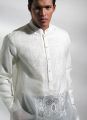
A barong tagalog made for a wedding ceremony

Alim Khan's bemedaled robe conveys a social message about his wealth, status, and power.


Religion
Some religious clothing might be considered a special case of occupational clothing. Sometimes it is worn only during religious ceremonies. However, it may be worn every day as a marker for a special religious status. For example, Sikhs wear a turban as it is a part of their religion.
In some religions, such as Hinduism, Sikhism, Buddhism, and Jainism, the cleanliness of religious dresses is of paramount importance and considered to indicate purity. Jewish ritual requires rending (tearing) of one's upper garment as a sign of mourning. The Quran says about husbands and wives, regarding clothing: "...They are clothing/covering (Libaas) for you; and you for them" (chapter 2:187). Christian clergy members wear religious vestments during liturgical services and may wear specific non-liturgical clothing at other times.
Clothing appears in numerous contexts in the Bible. Prominent passages are: Joseph's coat of many colors and the clothing of Judah and Tamar, Mordecai and Esther. Furthermore, the priests officiating in the Temple in Jerusalem wore very specific garments; the lack of them made one liable to death.

The Buddha wearing kāṣāya robes, originating from ancient India. Fully ordained Buddhist monks and nuns wore these robes.

Clerical clothing worn by Catholic priests

Hasidic Jews are noted for their distinctive attire
.jpeg)


Contemporary clothing
_(cropped).jpg)
The Western dress code has changed over the past 500+ years. The mechanization of the textile industry made a wide variety of cloth widely available at affordable prices. Styles have changed, and the availability of synthetic fabrics has altered the definition of what is "stylish." In the latter half of the twentieth century, blue jeans became very popular and are now worn to events that normally call for formal attire. Activewear has also become a large and growing market.
The licensing of designer names was pioneered by designers such as Pierre Cardin, Yves Saint Laurent, and Guy Laroche in the 1960s and has been a common practice within the fashion industry from about the 1970s. Among them are Marc Jacobs and Gucci, named after Marc Jacobs and Guccio Gucci, respectively.
Ethnic and cultural heritage
People may wear ethnic or national dress on special occasions or in certain roles or occupations. For example, most Korean men and women have adopted Western-style dress for daily wear, but still wear traditional hanboks on special occasions, such as weddings and cultural holidays. Also, items of Western dress may be worn or accessorized in distinctive, non-Western ways. A Tongan man may combine a used T-shirt with a Tongan wrapped skirt, or tupenu.
Sport and activity
For practical, comfort, or safety reasons, most sports and physical activities are practiced wearing special clothing. Common sportswear garments include shorts, T-shirts, tennis shirts, leotards, tracksuits, and trainers. Specialized garments include wet suits (for swimming, diving, or surfing), salopettes (for skiing), and leotards (for gymnastics). Also, spandex is often used as a base layer to wick away sweat. Spandex is preferable for active sports that require form-fitting garments, such as volleyball, wrestling, track and field, dance, gymnastics, and swimming.
Fashion
Paris set the 1900–1940 fashion trends for Europe and North America. Day dresses had drop waists, sashes or belts around the low waist or hip, and a skirt that hung anywhere from the ankle on up to the knee. Day wear had sleeves (long to mid-bicep) and a skirt that was straight, pleated, hemmed, or tiered. Jewelry was not conspicuous.
In the early twenty-first century, a diverse range of styles exists in fashion, varying by geography, exposure to modern media, and economic conditions, ranging from expensive haute couture to traditional garb to thrift store grunge. Designers showcase new and often extravagant designs at fashion shows.
Clothing maintenance
Clothing suffers assault both from within and without. The human body sheds skin cells and oils and excretes sweat, urine, and feces, which may soil clothing. From the outside, sun damage, moisture, abrasion, and dirt assault garments. Fleas and lice can hide in seams. If not cleaned and refurbished, clothing becomes worn. It loses its aesthetics and functionality (as when buttons fall off, seams come undone, fabrics thin or tear, and zippers fail).
Some materials present problems. Cleaning leather is difficult, and bark cloth (tapa) cannot be washed without dissolving it. Owners may patch tears and rips, and brush off surface dirt, but materials such as these inevitably age.
Most clothing consists of cloth, however, and most cloth can be laundered and mended (patching and darning).
Laundry, ironing, storage

Humans have developed many specialized methods for laundering clothing, ranging from early methods of pounding clothes against rocks in running streams, to the latest in electronic washing machines and dry cleaning (dissolving dirt in solvents other than water). Hot water washing (boiling), chemical cleaning, and ironing are all traditional methods of sterilizing fabrics for hygiene purposes.
Many kinds of clothing are designed to be ironed before they are worn to remove wrinkles. Most modern formal and semi-formal clothing is in this category (for example, dress shirts and suits). Ironed clothes are believed to look clean, fresh, and neat. Much contemporary casual clothing is made of knit materials that do not readily wrinkle and do not require ironing. Some clothing is permanent press, having been treated with a coating (such as polytetrafluoroethylene) that suppresses wrinkles and creates a smooth appearance without ironing. Excess lint or debris may end up on the clothing between launderings. In such cases, a lint remover may be useful.
Once clothes have been laundered and possibly ironed, they are usually hung on clothes hangers or folded, to keep them fresh until they are worn. Clothes are folded to allow them to be stored compactly, to prevent creasing, to preserve creases, or to present them more pleasingly, for instance, when they are put on sale in stores.
Certain types of insects and larvae feed on clothing and textiles, such as the black carpet beetle and clothing moths. To deter such pests, clothes may be stored in cedar-lined closets or chests, or placed in drawers or containers with materials having pest repellent properties, such as lavender or mothballs. Airtight containers (such as sealed, heavy-duty plastic bags) may also deter insect pests from damaging clothing materials.
Mending
When the raw material – cloth – was worth more than labor, it made sense to expend labor in saving it. In past times, mending was an art. A meticulous tailor or seamstress could mend rips with thread raveled from hems and seam edges so skillfully that the tear was practically invisible. Today, clothing is considered a consumable item. Mass-manufactured clothing is less expensive than the labor required to repair it. Many people buy a new piece of clothing rather than spend time mending. The thrifty still replace zippers and buttons and sew up ripped hems, however. Other mending techniques include darning and invisible mending or upcycling through visible mending inspired in Japanese Sashiko.
Recycling
_munitions_factory_(I0004928).jpg)
Used, unwearable clothing can be repurposed for quilts, rags, rugs, bandages, and many other household uses. Neutral colored or undyed cellulose fibers can be recycled into paper. In Western societies, used clothing is often thrown out or donated to charity. It is also sold to consignment shops, dress agencies, flea markets, and in online auctions. Also, used clothing is often collected on an industrial scale for sorting and shipment to poorer countries for reuse.
Controversies
Garments industry

Although mechanization transformed most aspects of the human clothing industry, by the mid-twentieth century, garment workers continued to labor under challenging conditions that demanded repetitive manual labor. Often, mass-produced clothing is made in what some consider sweatshops, typified by long work hours, lack of benefits, and lack of worker representation. While most examples of such conditions are found in developing countries, clothes made in industrialized nations may also be manufactured under similar conditions.
Coalitions of NGOs, designers (including Katharine Hamnett, American Apparel, Veja, Quiksilver, eVocal, and Edun), and campaign groups such as the Clean Clothes Campaign (CCC) and the Institute for Global Labour and Human Rights as well as textile and clothing trade unions have sought to improve these conditions by sponsoring awareness-raising events, which draw the attention of both the media and the general public to the plight of the workers.
Outsourcing production to low wage countries such as Bangladesh, China, India, Indonesia, Pakistan, and Sri Lanka became possible when the Multi Fibre Agreement (MFA) was abolished. Although many countries recognize treaties such as the International Labour Organization, which attempt to set standards for worker safety and rights, several countries have made exceptions to certain parts of the treaties or failed to enforce them thoroughly. Nevertheless, the production of textiles has served as a consistent industry for developing nations, providing work and wages to millions of people.
Fur
The use of animal fur in clothing dates to prehistoric times.[14] More recently, although fur is still used by indigenous people in Arctic regions and at higher elevations for its warmth and protection, in developed countries it is associated with expensive designer clothing.[15]
Once uncontroversial, recently it has been the focus of campaigns by groups such as PETA and other animal and animal liberation groups which have called attention to fur farming and other practices they consider cruel. Several fashion weeks banned real fur in its runway shows following protests and government attention to the issue.[16][17] Fashion houses such as Gucci, Versace, and Chanel have banned the use of fur in their garments.[18] Additionally, several governing bodies have enacted legislation banning the sale of new real-fur garments.
Notes
- ↑ Linda Baumgarten, What Clothes Reveal: The Language of Clothing in Colonial and Federal America (Yale University Press, 2002, ISBN 978-0300095807).
- ↑ Denisova Cave Yields a 50,000-Year-Old Needle Archaeology Magazine, August 23, 2016. Retrieved June 16, 2026.
- ↑ Eliso Kvavadze, Ofer Bar-Yosef, Anna Belfer-Cohen, Elisabetta Boaretto, Nino Jakeli, Zinovi Matskevich, and Tengiz Meshveliani, 30,000 Years old wild flax fibers - Testimony for fabricating prehistoric linen Science 325(5946) (2009): 1359. Retrieved June 16, 2026.
- ↑ Nicola Davis, Scientists find evidence of humans making clothes 120,000 years ago The Guardian, September 16, 2021. Retrieved June 16, 2026.
- ↑ Jarrett A. Lobell, World's Oldest Dress Archaeology Magazine 70(1) (2017). Retrieved June 16, 2026.
- ↑ Jarrett A. Lobell, Dressing for the Ages Archaeology Magazine 69(3) (2016):9. Retrieved June 16, 2026.
- ↑ John Carl Flugel, The Psychology of Clothes (Tradd Street Press, 2026 (original 1930), ISBN 978-1025936819).
- ↑ 8.0 8.1 8.2 8.3 8.4 8.5 Guowen Song (ed.), Improving Comfort in Clothing (Woodhead Publishing, 2011, ISBN 978-1845695392).
- ↑ Dorothy Siegert Lyle, Modern Textiles (John Wiley & Sons, 1982, ISBN 978-0471078050).
- ↑ Chi-wai Kan, Po-yee Sharon Li, and Ka-po Maggie Tang, Thermophysiological Comfort of Apparel Fabrics (Lambert Academic Publishing, 2014, ISBN 978-3659622557).
- ↑ Billie J. Collier, Martin J. Bide, and Phyllis G. Tortora, Understanding Textiles (Pearson College Div, 2008, ISBN 978-0131187702).
- ↑ J. Fan and L. Hunter, Engineering Apparel Fabrics and Garments (Woodhead Publishing, 2009, ISBN 978-1845691349).
- ↑ 13.0 13.1 Karen Tranberg Hansen, The World in Dress: Anthropological Perspectives on Clothing, Fashion, and Culture Annual Review of Anthropology 33 (2004): 369-392. Retrieved June 20, 2026.
- ↑ Brian Handwerk, Evidence of Fur and Leather Clothing, Among World's Oldest, Found in Moroccan Cave Smithsonian Magazine, September 16, 2021. Retrieved June 20, 2026.
- ↑ R. Turner Wilcox, The Mode in Furs: A Historical Survey with 680 Illustrations (Dover Publications, 2010, ISBN 978-0486478722).
- ↑ Copenhagen Fashion Week Bans Fur After PETA Protest Vegconomist, August 16, 2022. Retrieved June 20, 2026.
- ↑ London Fashion Week to go fur-free for the first time BBC, September 7, 2018. Retrieved June 20, 2026.|
- ↑ Colleen Kratofil, Luxury Fashion Brands That Are Anti-Fur People, June 30, 2021. Retrieved June 20, 2026.
ReferencesISBN links support NWE through referral fees
- Baumgarten, Linda. What Clothes Reveal: The Language of Clothing in Colonial and Federal America. Yale University Press, 2002. ISBN 978-0300095807
- Collier, Billie J., Martin J. Bide, and Phyllis G. Tortora. Understanding Textiles. Pearson College Div, 2008. ISBN 978-0131187702
- Fan, J., and L. Hunter. Engineering Apparel Fabrics and Garments. Woodhead Publishing, 2009. ISBN 978-1845691349
- Finnane, Antonia. Changing Clothes in China: Fashion, History, Nation. Columbia University Press, 2008. ISBN 978-0231143509
- Kan, Chi-wai, Po-yee Sharon Li, and Ka-po Maggie Tang. Thermophysiological Comfort of Apparel Fabrics. Lambert Academic Publishing, 2014. ISBN 978-3659622557
- Lyle, Dorothy Siegert. Modern Textiles. John Wiley & Sons, 1982. ISBN 978-0471078050
- Song, Guowen (ed.). Improving Comfort in Clothing. Woodhead Publishing, 2011. ISBN 978-1845695392
- Wilcox, R. Turner. The Mode in Furs: A Historical Survey with 680 Illustrations. Dover Publications, 2010. ISBN 978-0486478722
External links
All links retrieved June 20, 2026.
- Fabricating Fashion: Textiles for Dress, 1700–1825 Textile Society of America
- International Textile and Apparel Association (ITAA)
- A Beginners Guide to Fabric Types Hawthorn
- What Are Textiles: A Guide to Fashion Fabrics Glam Observer
- Textiles European Environment Agency
- Origin of Clothing: Tracing Humanity’s Textile Journey from Prehistory to Modernity Textile School
Credits
New World Encyclopedia writers and editors rewrote and completed the Wikipedia article in accordance with New World Encyclopedia standards. This article abides by terms of the Creative Commons CC-by-sa 3.0 License (CC-by-sa), which may be used and disseminated with proper attribution. Credit is due under the terms of this license that can reference both the New World Encyclopedia contributors and the selfless volunteer contributors of the Wikimedia Foundation. To cite this article click here for a list of acceptable citing formats.The history of earlier contributions by wikipedians is accessible to researchers here:
The history of this article since it was imported to New World Encyclopedia:
Note: Some restrictions may apply to use of individual images which are separately licensed.

