Electrical conductivity
Electrical conductivity or specific conductivity is a measure of a material's ability to conduct an electric current. When an electrical potential difference is placed across a conductor, its movable charges flow, giving rise to an electric current. The conductivity σ is defined as the ratio of the current density to the electric field strength :


It is also possible to have materials in which the conductivity is anisotropic, in which case σ is a 3×3 matrix (or more technically a rank-2 tensor) which is generally symmetric.
Conductivity is the reciprocal (inverse) of electrical resistivity and has the SI units of siemens per meter (S•m-1) i.e. if the electrical conductance between opposite faces of a one-meter cube of material is one Siemens then the material's electrical conductivity is one Siemens per meter. Electrical conductivity is commonly represented by the Greek letter σ, but κ or γ are also occasionally used.
An EC meter is normally used to measure conductivity in a solution.
Classification of materials by conductivity
- A conductor such as a metal has high conductivity.
- An insulator like glass or a vacuum has low conductivity.
- The conductivity of a semiconductor is generally intermediate, but varies widely under different conditions, such as exposure of the material to electric fields or specific frequencies of light, and, most important, with temperature and composition of the semiconductor material.
The degree of doping in solid state semiconductors makes a large difference in conductivity. More doping leads to higher conductivity. The conductivity of a solution of water is highly dependent on its concentration of dissolved salts and sometimes other chemical species which tend to ionize in the solution. Electrical conductivity of water samples is used as an indicator of how salt-free or impurity-free the sample is; the purer the water, the lower the conductivity.
Understanding conductors and insulators
All conductors contain electric charges which will move when an electric potential difference (measured in volts) is applied across separate points on the material. This flow of charge (measured in amperes) is what is meant by electric current. In most materials, the rate of current is proportional to the voltage (Ohm's law), provided the temperature remains constant and the material remains in the same shape and state. The ratio between the voltage and the current is called the resistance (measured in ohms) of the object between the points where the voltage was applied. The resistance across a standard mass (and shape) of a material at a given temperature is called the resistivity of the material. The inverse of resistance and resistivity is conductance and conductivity. Some good examples of conductors are metal.
Most familiar conductors are metallic. Copper is the most common material for electrical wiring, (silver is the best but expensive), and gold for high-quality surface-to-surface contacts. However, there are also many non-metallic conductors, including graphite, solutions of salts, and all plasmas.
Non-conducting materials lack mobile charges, and so resist the flow of electric current, generating heat. In fact, all materials offer some resistance and warm up when a current flows. Thus, proper design of an electrical conductor takes into account the temperature that the conductor needs to be able to endure without damage, as well as the quantity of electrical current. The motion of charges also creates an electromagnetic field around the conductor that exerts a mechanical radial squeezing force on the conductor. A conductor of a given material and volume (length x cross-sectional area) has no real limit to the current it can carry without being destroyed as long as the heat generated by the resistive loss is removed and the conductor can withstand the radial forces. This effect is especially critical in printed circuits, where conductors are relatively small and close together, and inside an enclosure: the heat produced, if not properly removed, can cause fusing (melting) of the tracks.
Since all conductors have some resistance, and all insulators will carry some current, there is no theoretical dividing line between conductors and insulators. However, there is a large gap between the conductance of materials that will carry a useful current at working voltages and those that will carry a negligible current for the purpose in hand, so the categories of insulator and conductor do have practical utility.
Some electrical conductivities
| Electrical Conductivity
(S•m-1) |
Temperature(°C) | Notes | |
|---|---|---|---|
| Silver | 63.01 × 10⁶ | 20 | Highest electrical conductivity of any metal |
| Copper | 59.6 × 10⁶ | 20 | |
| Annealed Copper | 58.0 × 10⁶ | 20 | Referred to as 100 percent IACS or International Annealed Copper Standard. The unit for expressing the conductivity of nonmagnetic materials by testing using the eddy-current method. Generally used for temper and alloy verification of Aluminum. |
| Gold | 45.2 × 10⁶ | 20 | Gold is commonly used in electrical contacts |
| Aluminum | 37.8 × 10⁶ | 20 | |
| Seawater | 5 | 23 | Refer to Kaye and Laby for more detail as there are many variations and significant variables for seawater.
5(S•m-1) would be for an average salinity of 35 g/kg at about 23(°C) Copyright on the linked material can be found here. Maybe someone could contact NPL and ask if their information could be reproduced in a separate page here. |
| Drinking water | 0.0005 to 0.05 | This value range is typical of high quality drinking water and not an indicator of water quality | |
| deionized water | 5.5 × 10⁻⁶[1] | changes to 1.2 × 10⁻⁴ in water with no gas present[1] |
Complex conductivity
To analyze the conductivity of materials exposed to alternating electric fields, it is necessary to treat conductivity as a complex number (or as a matrix of complex numbers, in the case of anisotropic materials mentioned above) called the admittivity. This method is used in applications such as electrical impedance tomography, a type of industrial and medical imaging. Admittivity is the sum of a real component called the conductivity and an imaginary component called the susceptivity.[2]
An alternative description of the response to alternating currents uses a real (but frequency-dependent) conductivity, along with a real permittivity. The larger the conductivity is, the more quickly the alternating-current signal is absorbed by the material (i.e., the more opaque the material is). For details, see Mathematical descriptions of opacity.
Temperature dependence
Electrical conductivity is strongly dependent on temperature. In metals, electrical conductivity decreases with increasing temperature, whereas in semiconductors, electrical conductivity increases with increasing temperature. Over a limited temperature range, the electrical conductivity can be approximated as being directly proportional to temperature. In order to compare electrical conductivity measurements at different temperatures, they need to be standardized to a common temperature. This dependence is often expressed as a slope in the conductivity-vs-temperature graph, and can be used:
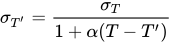
where
- σT′ is the electrical conductivity at a common temperature, T′
- σT is the electrical conductivity at a measured temperature, T
- α is the temperature compensation slope of the material,
- T is the measured absolute temperature,
- T′ is the common temperature.
The temperature compensation slope for most naturally occurring waters is about two %/°C, however it can range between (one to three) %/°C. This slope is influenced by the geochemistry, and can be easily determined in a laboratory.
At extremely low temperatures (not far from absolute zero K), a few materials have been found to exhibit very high electrical conductivity in a phenomenon called superconductivity.
See also
- Electrical conductor
- Electrical resistance
- Electrical resistivity
- Electricity
- Insulator (electrical)
- Metal
- Semiconductor
- Thermal conductivity
Notes
- ↑ 1.0 1.1 See J. Phys. Chem. B 2005, 109, 1231-1238 In particular page 1235. Note that values in this paper are given in S/cm, not S/m, which differs by a factor of 100. Retrieved September 25, 2008.
- ↑ Otto H. Schmitt, Mutual Impedivity Spectrometry and the Feasibility of its Incorporation into Tissue-Diagnostic Anatomical Reconstruction and Multivariate Time-Coherent Physiological Measurements University of Minnesota. Retrieved September 25, 2008.
ReferencesISBN links support NWE through referral fees
- Giancoli, Douglas. Physics for Scientists and Engineers, with Modern Physics (Chapters 1-37), 4th ed. Mastering Physics Series. Upper Saddle River, NJ: Prentice Hall, 2007. ISBN 978-0136139263
- Maini, A.K. Electronics and Communications Simplified, 9th ed. New Delhi: Khanna Publishers, 1997.
- Plonus, Martin. Electronics and Communications for Scientists and Engineers. San Diego: Harcourt/Academic Press, 2001. ISBN 0125330847
- Tipler, Paul Allen, and Gene Mosca. Physics for Scientists and Engineers, Volume 2: Electricity and Magnetism, Light, Modern Physics, 5th ed. New York: W.H. Freeman, 2004. ISBN 0716708108
External links
All links retrieved February 13, 2024.
- Measurement of the Electrical Conductivity of Glass Melts Measurement Techniques, Definitions, Electrical conductivity Calculation from the Glass Composition
- Periodic Table of Elements Sorted by Electrical Conductivity
Credits
New World Encyclopedia writers and editors rewrote and completed the Wikipedia article in accordance with New World Encyclopedia standards. This article abides by terms of the Creative Commons CC-by-sa 3.0 License (CC-by-sa), which may be used and disseminated with proper attribution. Credit is due under the terms of this license that can reference both the New World Encyclopedia contributors and the selfless volunteer contributors of the Wikimedia Foundation. To cite this article click here for a list of acceptable citing formats.The history of earlier contributions by wikipedians is accessible to researchers here:
The history of this article since it was imported to New World Encyclopedia:
Note: Some restrictions may apply to use of individual images which are separately licensed.

